
Austin AI Hub to lead the global challenge, launching alongside one of the largest international sporting events in modern history and culminating on the United Nations World Day Against Trafficking in Persons.
Geneva, Switzerland — April 30, 2026 — One hundred years ago, in this city, the nations of the world gathered under the League of Nations and signed the first international convention to abolish slavery — a promise made on behalf of all humanity.
That promise remains broken.
Slavery, as the 1926 Convention defined it, is the condition of being held under the powers of ownership — stripped of freedom, stripped of choice, stripped of self. A century later, that condition persists - although without chains, in contemporary forms and through new channels in all regions of the globe.
Today, more than 50 million people are trapped in forced labor, bonded labour, child, early and forced marriage, domestic servitude, worst forms of child labour, trafficking in persons, and other forms of exploitation, including in the digital space. Fewer than half of one percent will ever be identified. The systems meant to protect them have not kept pace with the networks that exploit them.
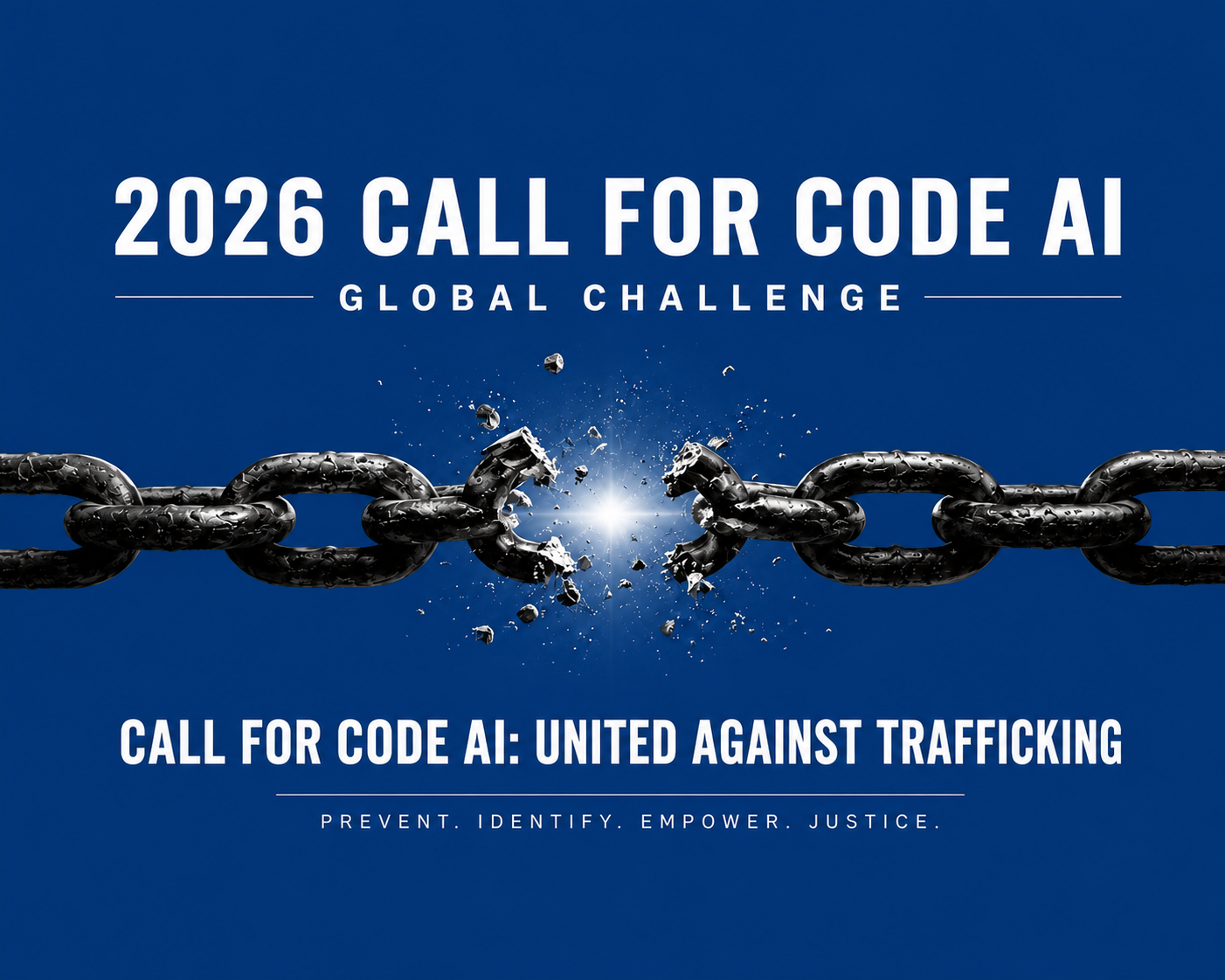
In response, Call for Code AI — together with United Nations Human Rights and Austin AI Hub — is launching Call for Code AI: United Against Trafficking, a global developer challenge designed to detect, prevent, and disrupt trafficking networks using artificial intelligence. The initiative is proud to support the United Nations Voluntary Trust Fund on Contemporary Forms of Slavery — the UN Slavery Fund — the challenge’s official beneficiary, which for decades has delivered direct humanitarian, legal, medical, social and psychological assistance to survivors around the world.
The hybrid challenge launches June 11, 2026, alongside the opening of one of the largest international sporting events in modern history, and culminates July 30 on the United Nations World Day Against Trafficking in Persons. Designed as an annual initiative, the challenge will align each year with the UN’s World Day Against Trafficking to deepen impact over time.
Why This Moment Matters
2026 presents a convergence the world has not seen before: the centenary of the 1926 Slavery Convention, the first international legal framework aimed at abolishing slavery and the slave trade; and the emergence of AI systems capable of identifying patterns, predicting risk, and disrupting criminal networks at a scale no human effort alone can match.
This is not a moment to act because the timing is convenient. It is a moment to act because it is unavoidable.
"If AI cannot be deployed to protect the most vulnerable among us, it has failed its highest purpose," said David Clark, Founder & CEO, Call for Code AI. "If we free one person, this will have been worth it. If we ignite the movement that frees thousands, we will count ourselves the most privileged builders of our generation."
Developers are not being asked to experiment. They are being asked to build AI systems aligned with international human rights norms and standards — at a moment where historical reckoning, institutional authority, and technological capability converge.
A Global Call to Build Where It Matters
This is a call to the world’s developers, researchers, designers, and advocates — not as participants in a competition, but as architects of systems the world urgently needs.
Fifty million people need solutions that do not yet exist.
The challenge asks them to build AI systems that:
- Increase victim identification by detecting patterns of trafficking in persons for purposes of labour and/or sexual exploitation across borders, supply chains, and digital networks.
- Prevent exploitation before it occurs by identifying risk at scale.
- Support survivors with tools grounded in dignity, privacy, human rights, and long-term resilience.
- Strengthen legal accountability, access to justice and remedy, and prosecution pathways.
“Human trafficking is a grave violation of human rights that demands coordinated and innovative responses. By engaging the global developer community through Call for Code AI, this initiative demonstrates how technology can be aligned with dignity, privacy, and accountability — helping ensure protection is strengthened rather than compromised.”
— Anwar Mahfoudh, Chief, Innovation & Analytics Hub, UN Human Rights
The question is not whether AI can help. It is whether the people who build it will direct it where it matters most.
Winning teams will be recognized on the United Nations World Day Against Trafficking in Persons — placing their work on a UN-designated platform visible to governments, institutions, and the worldwide developer community.
A Proven Platform, Transformed for an Urgent Crisis
Call for Code began in 2018 as a challenge — and became a movement. More than one million developers across 190 countries answered that call, producing over 50,000 solutions for disaster response, climate resilience, public health, and human rights.
Now the platform enters a new phase. Call for Code AI marks the shift from participation to deployment, from ideas to accountability — a platform engineered not just to generate solutions, but to ensure they reach the people and systems that need them most.
Each partner brings a distinct and essential role:
- United Nations Human Rights embeds international human rights standards into the challenge framework, ensuring every solution prioritizes human dignity and rights as a whole.
- Austin AI Hub leads hackathon strategy, design, and execution — bringing applied ethical AI expertise and direct collaboration with survivor-serving organizations.
- The UN Voluntary Trust Fund on Contemporary Forms of Slavery (the UN Slavery Fund) serves as the challenge’s official beneficiary, ensuring the momentum generated by this work translates directly into support for the survivors of the very crimes it seeks to end.
“We are honored to collaborate with Call for Code AI and United Nations Human Rights on this challenge. This partnership reflects our commitment to ensuring AI is developed responsibly and applied where it can create measurable protection for vulnerable communities.”
— Mia Cheraghian, PhD, Director of Strategic Partnerships & Marketing, Austin AI Hub
Call for Code AI is no longer asking what technology can do. It is proving where technology must go.
Challenge Tracks
Participants may compete across three core tracks:
- Anticipate & Disrupt — AI systems designed to detect and disrupt trafficking networks before they reach their targets.
- Assist & Amplify — Survivor-centered AI tools supporting identification, recovery, protection, and long-term resilience.
- Accountability & Justice — AI systems strengthening victim reporting of abuse and exploitation, legal processes, evidence gathering, and prosecution pathways.
Special Recognition: Art Against Trafficking — highlighting the use of AI in storytelling, media, and public engagement to shift awareness and mobilize action.
For full track details and technical requirements, visit: https://austinaihub.org
Registration is now open at: https://hackathon.austinaihub.org
Participants may compete virtually or in person in Austin, Texas.
Recognition with Global Significance
The United Nations World Day Against Trafficking in Persons is an official UN observance recognized by all 193 Member States. Solutions recognized through this challenge will stand at the intersection of technological innovation and international human rights standards — offering a rare alignment of institutional credibility, worldwide visibility, and real-world deployment.
Beyond the Hackathon
July 30 marks the conclusion of the challenge — and the beginning of sustained work. Austin AI Hub will continue building an ecosystem of AI innovation dedicated to combating human trafficking: advancing open-source collaboration, survivor-centered tools, and systems that strengthen prevention and legal accountability worldwide.
The hackathon is the catalyst. What follows is the sustained work required to confront one of the most persistent human rights violations of our time.
The crime that has outlasted a century of progress now faces a generation with the tools to end it — and a charge to confront the root causes that enable exploitation: poverty, discrimination, and the lack of access to education, decent work, and opportunity.
Timeline
- May 1, 2026: Global registration opens.
- June 11, 2026: Challenge launches.
- July 30, 2026: Winners announced on the United Nations World Day Against Trafficking in Persons.
The initiative operates as a hybrid program, with online participation worldwide and in-person components hosted in Austin, Texas.
Call for Code AI: United Against Trafficking is supported by leading charities working to prevent trafficking and support survivors, including Allies Against Slavery, redM, Magdalene House of Austin, and Sentinel Foundation.
This initiative is independently organized and is not affiliated with or endorsed by any sporting organization or governing body.
About
Call for Code AI
Call for Code AI is a global developer platform founded in 2018 to build, test, and deploy technology solutions addressing the world’s most pressing challenges. Having mobilized more than one million developers across 190 countries and produced over 50,000 solutions, the platform has helped define standards for responsible, real-world AI deployment. United Nations Human Rights serves as Global Impact Partner.
United Nations Human Rights — Global Impact Partner
The Office of the United Nations High Commissioner for Human Rights (United Nations Human Rights) is the leading global authority on the promotion, protection, and realization of human rights and fundamental freedoms for all people. Operating in more than 100 countries on behalf of all 193 UN Member States, United Nations Human Rights works to advance dignity, equality, and justice at every level of society. As the founding global partner of Call for Code AI, United Nations Human Rights brings institutional authority and worldwide reach to a platform built on the conviction that technology, guided by human rights principles, can protect the most vulnerable and drive systemic change.
Austin AI Hub — Official AI Hub
Austin AI Hub is a purpose-driven artificial intelligence community based in Austin, Texas, advancing inclusive, ethical, and practical AI education. Through open-source collaboration and cross-sector partnerships, the Hub empowers technologists to apply AI for measurable social impact, with a sustained focus on combating human trafficking.
UN Voluntary Trust Fund on Contemporary Forms of Slavery — Official Beneficiary
More than 50 million people around the world remain enslaved today. The UN Voluntary Trust Fund on Contemporary Forms of Slavery brings relief to those whose human rights have been severely violated as a result of this affront to human dignity — abolished worldwide, yet persisting in practice. By awarding grants to civil society organizations, the Fund ensures that thousands of men, women, and children subjected to slavery around the world today receive humanitarian, psychological, social, legal, medical, financial, and other assistance.







© Copyright 2025 / David Clark Cause, Inc.